
O artigo vale a pena.
Alguém quer fazer um parecido... em português?
Teaching and learning | Elizabeth Hutchinson School Libraries | I know we need a school librarian, but I can't remember why...


RESEARCH (2012) CONCLUSIONThis study adds to the evidence that all K–12 students need and deserve quality school library programs with full-time certified staff. Students are more likely to succeed when they have library programs that are well staffed, well funded, technologically well equipped, well stocked, and more accessible. And, the neediest learners may benefit the most from trained librarians and quality library programs.However, much work still needs to be done to use this research to reach influential stakeholders who control the future of school library programs and their staffing. While many states are pursuing state reforms and regulations, this doesn’t negate the role of the individual school librarian to learn and share these findings locally. Everyone needs to nurture library champions who will defend the position that all K–12 school students need and deserve full-time school librarians and well-resourced school libraries in order to develop the skills needed to be productive in the 21st century.
Actually, there are two points that I saw in the article which highlight ‘some of the activities of librarians do within their schools to make these students perform so much better in school’ as you requested.- teaching the Standards for the 21st-Century Learner, and- teaching inquiry-based learning.You can see the information in the section titled “The role of the school library program and academic standards”. The information mentions “dramatically higher scores” and students being less likely to score below basic.Also, I think you are correct that the “cataloging and shelving” activities you mention do not make the difference in student achievement. That is probably why schools where the full-time librarians have support staff do better than where there is no support staff (because the support staff would be doing the cataloging and shelving type activities and the librarian would be spending more of his/her time teaching the 21st century skills and inquiry-based learning activities that make the difference).


|
| From anethicalisland.wordpress.com -April 14, 11:42 PM |
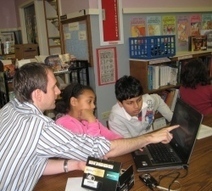
1. Teachers are committed to students and their learning.2. Teachers know the subjects they teach and how to teach those subjects tostudents.3. Teachers are responsible for managing and monitoring student learning.4. Teachers think systematically about their practice and learn from experience.5. Teachers are members of learning communities.
(...)
The National Board for Professional Teaching Standards has organized the standards for accomplished library media specialists into the following ten standards. The standards have been ordered to facilitate understanding, not to assign priorities. They each describe an important facet of accomplished teaching; they often occur concurrently because of the seamless quality of accomplished practice. These standards serve as the basis for National Board Certification in library media.
in Library Media Standards for teachers of students ages 3-18+, publicado pelo National Board of Professional Teaching Standards da Austrália, 2ª ed. 2012.
In the United States, a teacher-librarian must have a baccalaureate degree and a certificate in secondary or elementary education, and must also complete a school library media program and gain a state certification. Programs in library science vary between institutions; however, state requirements must be met before a library media specialist is allowed to teach. Some school library media specialists hold the full Masters of Library Science (MLS) or Masters of Library Information Science (MLIS) degree, while others do not. In many instances, school librarians who have an MLS but do not have the requisite teaching credentials must obtain these teaching credentials and classroom teaching experience first before they are permitted to work as teacher-librarians, and often additional library science graduate coursework is required, focused specifically on issues pertaining to school librarianship.Certification requirements vary widely from state to state, as does the title of the SLMS.[1] Some of the coursework may include collaboration skills, cataloging, technology, collection development, children’s and young adult literature, advanced research methods, and various other topics.


The third Colorado study has been completed, published at the end of 2010. The original Colorado study was conducted in 1993 and the second in 2000. This latest study reconfirms the results of the previous two as evidenced in its title: School Librarians Continue to Help Students Achieve Standards: The Third Colorado Study (2010) [...]
The findings are consistent with both the previous Colorado studies and also the many other studies that have been conducted internationally over the past 10 years.
The ResultsSchools with at least one full time qualified librarian averaged better performance (in reading) than in schools with less than one FTE qualified librarian. Further, the findings show that in schools with full time librarians 4 % more students achieved higher results at the top end of the scoring and significantly, 3 % fewer students fell below the unsatisfactory mark.
Other results include similar impacts on measured reading achievement based on library expenditure (above or below the median per student), number of visits per child to the library (above or below the median of .42 visits per student per week), size of periodical and video collections.For the full report visit the Library Research ServiceNB: for this report Librarian was defined as “ an individual employed by a school as a librarian AND endorsed by the Department of Education as: Teacher Librarian or School Librarian or Media Specialist”

By Joyce Valenza (EUA)
I’d like future teacher librarians to leave their practicum mentors with a few fairly granular competencies—for instance, how best to present the elements of your program online—ones that don’t appear on your typical preservice checklist, but will prepare them for their real-life work with students and faculty. Competencies that will encourage them to continue to develop new skills.
With the understanding that this list will need revisiting every couple of years, here are my nonnegotiable requirements for 2011:
Advocate for learners. Advocate for strong school libraries. from Joyce Valenza on Vimeo.
As discussed in the report, training in digital literacy is rare in any pre-service teacher education training. The reference to this lack in “school district professional development” is really a green light for teacher librarians to get out there and put a school-based professional learning program together for the staff. (...)
- Technology is increasingly a means for empowering students, a method for communication and socialising, and a ubiquitous, transparent part of their lives. Once seen as an isolating influence, technology is now recognised as a primary way to stay in touch and take control of one’s own learning.
- Technology continues to profoundly affect the way we work, learn, socialise, play, collaborate, communicate and succeed. Increasingly, technology skills are also critical to success in almost every arena, and those who have substantial facility with technology will advance while those without access or skills will not.
- The perceived value of innovation and creativity is increasing. The ways we design learning experiences must reflect the growing importance of innovation and creativity as professional skills.
- There is increasing interest in just-in-time, alternate, or non-formal avenues of education, such as online learning, mentoring and independent study.
- The way we think of learning environments is changing. The ’spaces’ where students learn are becoming more community-driven, interdisciplinary and supported by technologies that engage virtual communication and collaboration.
Some of these trends also help teacher-librarians to have a foot in the door. For example, consider inquiry-based learning and how we design learning experiences to engage learners in information rich environments to develop higher order thinking, creativity and innovation. Or, school library design and developing learning spaces for students.

Daqui, 2009.06.27QUE VIVA A BIBLIOTECA ESCOLAR!FINALMENTE... “nasceram” [institucionalmente] as bibliotecas escolares! A mãe é a PORTARIA há dias conhecida [V. aqui] que institui a Biblioteca Escolar como o centro nevrálgico da aprendizagem e da escola.Parabéns ao Ministério da Educação que, só ao fim de treze anos, teve a literacia suficiente para assumir a necessidade daquilo que os Professores bibliotecários têm defendido apaixonadamente ao longo desses anos, com empenho e dedicação muitas vezes incompreendidos.Apesar de ser um passo decisivo na caminhada para um melhor ensino-aprendizagem, poderão, no futuro, ser problemáticos os efeitos da execução desta portaria, se não forem acautelados alguns aspectos que ficaram esquecidos. Entre estes aspectos salientamos a ainda nula referência aos Auxiliares de Acção Educativa, dado o seu papel essencial na constituição das equipas para o funcionamento, manutenção e estabilidade dos serviços da Biblioteca Escolar.Podemos, mesmo assim, comemorar os 13 anos da RBE com esta primeira e boa notícia:Nasceu a Biblioteca Escolar!... Que viva a Biblioteca Escolar!


