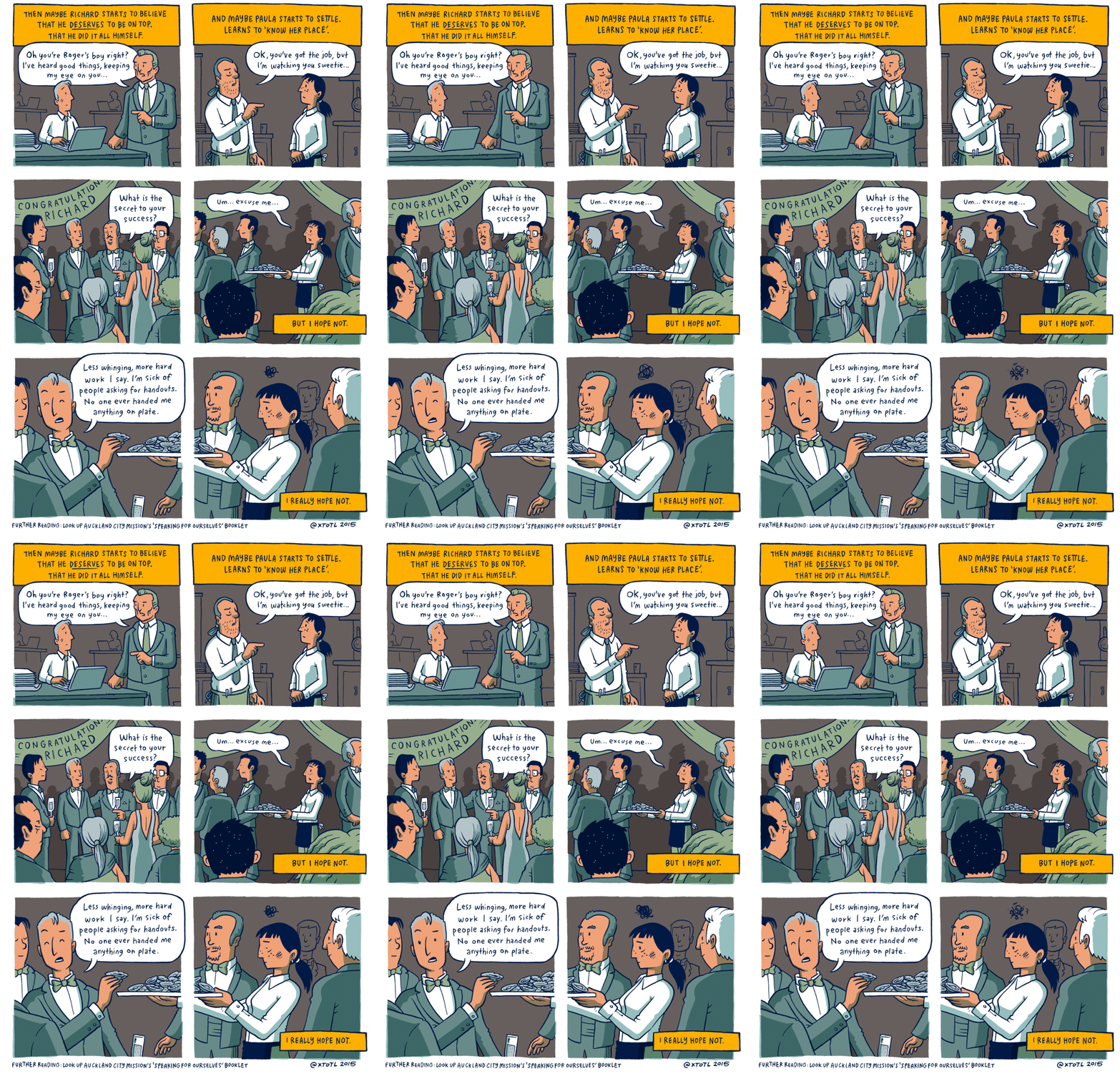
Students no longer have to wait for when they leave school to have an impact on the outside world, we can use the tools we have to do so right away.
Ler mais aqui http://pernillesripp.com/2015/06/23/the-future-of-literacy/
Students no longer have to wait for when they leave school to have an impact on the outside world, we can use the tools we have to do so right away.

“A maior parte dos professores pensa; ‘uma coisa é aula, que tem o livro, o caderno de fichas e o quadro preto, e outra coisa são os smartphones e os tablets. Errado. A escola do século XXI tem de ser diferente porque os alunos são diferentes”, remata o professor.


Action Plan for Good Libraries
And what about those libraries that fall in the middle?
The difference between a good library and a great library can be subtle. There are some very good libraries out there. These libraries are dedicated to making you happy and serving your needs. They have the latest in materials (books, DVDs, journal articles, etc.). Their websites are well organized and functional. They prize customer service and they get you what you need. They tend to collect a lot of data on the community and have active marketing. Many communities feel these libraries are meeting their expectations.
But if you want to see the difference between a good library and a great one, try visiting a Borders bookstore or a Blockbuster video store. You can’t. They don’t exist anymore. And when they closed, the only signs you saw were advertising clearance sales and deep discounts. But you know what signs you see when they try and close a great library? Signs of protest. You see picket lines. You see angry town hall meetings. Why? Well, that takes us back to the very first chapter. The reason why is because the library is part of the community. It is not a set of comfy chairs and an excellent collection. It is a symbol, and a friend, and a teacher.
But let’s be honest. Some libraries close with nary a whisper. Academic library budgets are downsized and corporations close their libraries. They close bad libraries, yes, but they also close good libraries. The difference between good and great comes down to this: a library that seeks to serve your community is good, and a library that seeks to inspire your community to be better every day is great. You can love a good library, but you need a great library. When you limit your expectations of a library to a supplier for your consumption, the library is in direct competition with Amazon, Google, and the local paper. But if you expect more—if you expect your library to be an advocate for you in the complex knowledge infrastructure—if you expect your library to be a center of learning and innovation—if you expect your library to help you create knowledge and not simply get you easy access to the work of others—if you expect your librarians to be personally concerned with your success—if you expect the library to be a third place that glues together a community—if you expect your library to inspire you, to challenge you, to provoke you, but always to respect you beyond your means to pay—then you expect a great library. You deserve a great library. Go out and get it!"

 |
| AfterCollege.png (1125×3750) |
Abstract: A trends report with preliminary findings from the lifelong learning survey Project Information Literacy administered to recent college graduates from 10 US colleges and universities during October 2014 through December 2014. Survey data was collected from college graduates (n=1,651) about their lifelong learning needs and information practices for their personal development, engagement in local communities, and for staying employable and competitive in the workplace. A majority of grads had a diffuse set of complex learning needs, which often overlapped. Grads relied on a mixed variety of information sources in their lives for staying informed, including search engines, books, blogs, social networks, co-workers, and friends. About half of the respondents credited college with helping them develop their competencies for extracting the information needed and evaluating the credibility of content. The survey results are revealing about the information competencies a majority of students may develop and master during their college years. Still, lifelong learning was not necessarily easier for grads: Many "strongly agreed" with the statement that finding time as well as locating affordable sources for learning after college was challenging.Ler mais aqui

The resulting model, InFlow, has been designed to encourage students to engage with information in a variety of ways as they map, explore, ask, make, reflect, imagine, show and collaborate. The rationale behind the development of this model raises fundamental questions about current teaching practices in relation to IL, such as the need to encourage collaborative working; the role of students as producers of information as well as consumers; and the privileging of particular types of information sources and outputs. This article describes the process by which this model was developed, based on approaches used in iTEC, and explains how it responds to criticisms of existing models. A short case study of the use of InFlow in a UK university library demonstrates how the model can work in practice to create IL programmes for students of the 21st century. (...)
The
findings of the iTEC project in relation to IL are, therefore,
supported by the wider literature; both suggest that existing IL
models do not adequately support emerging 21st century pedagogies.
However, a series of Learning Activities devised in the fourth iTEC
cycle (2013) appeared to offer a potential way to structure an IL
learning design model which could respond to the issues described
above. These learning activities were:
‘Dream’:
Introducing, understanding and questioning a design brief;
‘Explore’:
Collecting information in relation to the design brief;
‘Map’:
Creating a mind-map to understand relations between the collected
information;
‘Reflect’:
Recording audio-visual reflections and feedback;
‘Make’:
Creating a design; ‘Ask’:
Performing workshops with people who may represent future users of
the design;
‘Show’:
Publishing and presenting designs to an audience;
‘Collaborate’:
Form ad-hoc collaborations with learners from other schools.To
support teachers in the implementation of these Learning Activities,
the iTEC team prepared detailed descriptions for each activity, which
included a descriptive narrative, suggested classroom activities,
ideas for using technology, and potential teacher and student
outcomes.
Developing a new approach to information literacy learning design
Sarah McNicol, Emily Shields2014, Vol. 8, No. 2, pp. 23-35