terça-feira, 4 de novembro de 2014

5 FLUÊNCIAS

AS 5 FLUÊNCIAS PRINCIPAIS DA APRENDIZAGEM NO SÉC. XXI
Outubro 29, 2014
Hoje quero partilhar convosco esta fantástica leitura com que me deparei no Global Citizen Education. O título do artigo é 21st Century Fluencies. Baseia-se sobretudo no livro de Crockett e outros, Literacy is Not Enough.
O principal argumento deste texto é o de que as fluências do século XXI são competências processuais de que os estudantes necessitam para singrarem num mundo em rápida mudança. Estas competências processuais incluem coisas como pensamento crítico, resolução de problemas, criatividade, inovação, para só mencionar algumas. As fluências do século XXI”, como nos dizem os seus autores, “não tratam de hardware, são sobretudo headware (menteware) e heartware (coraçãoware).”

Fonte da imagem: http://goo.gl/GJKHzD


O artigo aprofunda as cinco principais fluências. Eis uma breve síntese de cada uma delas. Podem encontrar uma análise mais detalhada de cada uma delas no texto original.


"Fluência na Solução é a capacidade de pensar de forma criativa para resolver problemas em tempo real, definindo com clareza o problema, desenhando uma solução apropriada, concretizando a solução e, então, avaliando o processo e o resultado.”

Fluência Criativa é o processo pelo qual a proficiência artística adiciona significado através do design, da arte, e da narração de histórias. Tem a ver com o uso do design inovador para acrescentar valor à função de um produto através da sua forma.
"Fluência na Colaboração é uma perícia do trabalho em equipa que atingiu, no inconsciente, a capacidade de trabalhar de modo cooperativo com parceiros virtuais e reais em ambiente online, para resolver problemas e para criar produtos originais.”
" Há dois componentes na Fluência nos Media. Em primeiro lugar, a capacidade de olhar de forma analítica para qualquer comunicação para interpretar a mensagem real, e para avaliar a eficácia do mediumk escolhido. Em segundo lugar, criar comunicações originais alinhando a mensagem e a audiência através do medium mais adequado e efetivo.”
Fluência de Informação é a capacidade de, inconsciente e intuitivamente, interpretar informação em todas as formas e formatos, de modo a conseguir extrair o conhecimento essencial, autenticá-lo, e perceber o seu sentido e a sua significação.”


Trad. de inglês para português Maria José Vitorino 2014.11.04

domingo, 2 de novembro de 2014

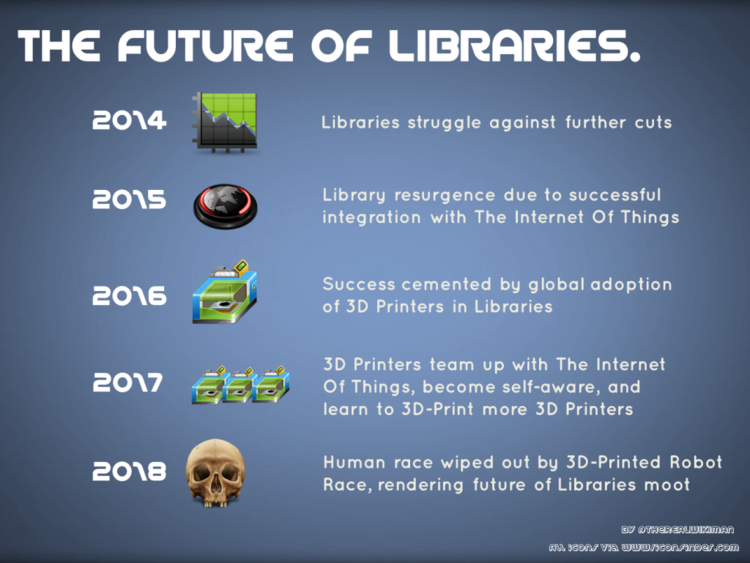
Let´s take a walk on the bright side?

 Libraries: People, Place, Platform - see slides 48-52, in:

Future internet of things and librarians

A imagem a baixo é de outra fonte

Imagem de Ned Potter, aqui

"Regardless of how the future unfolds, the Internet will evolve in ways we can only begin to imagine. By allowing ourselves to explore and rehearse divergent and plausible futures for the Internet, not only do we prepare for any future, we can also help shape it for the better."

Ler mai aqui:
The Future of the Internet | Pew Research Center's Internet & American Life Project

OECD educationtoday: How can education systems embrace innovation?


How to square these different views on innovation in education? Maybe the core of the dispute is not so much about the actual amount of change and innovation in education, but about the process - how change and innovation happen. A lot of well-intentioned innovations fail not because of a lack of quality or because their intended direction of change is wrong, but because of how they have been implemented. Teachers will be able to give you rich accounts of top-down innovations, implemented without much consultation, without taking into account the experiences and knowledge base at the point of delivery of education. Lack of trust, lack of ownership, a poor evidence base, and lack of empowerment of the key actors – these seem to be the main ingredients of the recipe for failure in changing education.


To better understand this, we need to know more about how the governance of education systems has changed. Many attempts to bring about innovative change in education do not yet seem to be based on what we already know about how education systems are governed. Decentralisation, greater complexity, multiplication of stakeholders, broader dispersion of knowledge and expertise, more levels of decision-making all make education systems more difficult to steer and to change. At least that’s the impression one gets when looking at the system from the outside. Indeed, the complexity and the multilevel nature of decision-making in education systems make top-down reform much more difficult to achieve. But complexity, in itself, does not necessarily jeopardise change through innovation.


OECD educationtoday: How can education systems embrace innovation?

quarta-feira, 29 de outubro de 2014

I Congresso de Leitura Digital – Vídeos e apresentações | Leituras Digitais

"Quem não teve oportunidade de participar no congresso, que se realizou nos passados dias 24 e 25 de Outubro, pode agora assistir aos vídeos do evento apresentados abaixo. Actualizarei também este artigo com as apresentações realizadas, à medida que estas forem sendo disponibilizadas online."
I Congresso de Leitura Digital – Vídeos e apresentações | Leituras Digitais

domingo, 26 de outubro de 2014

Education needs a broader definition of literacy | Social Theory Applied


In this day and age, literacy continues to be a powerful tool of emancipation. The Scottish Curriculum for Excellence defines it as
the set of skills which allows an individual to engage fully in society and in learning, through the different forms of language, and the range of texts, which society values and finds useful.

sexta-feira, 24 de outubro de 2014

9th Grade Digital Citizenship: Copyright? More Like Copy and Paste


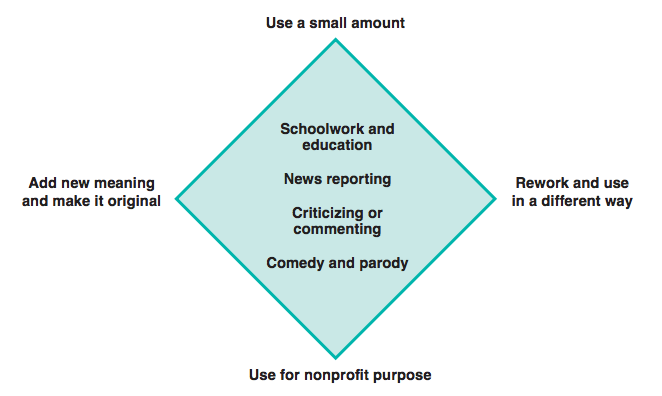
Fair use is to try to balance the right of the copyright holder and the public. Within fair use, there are eight factors:Use in small amount, rework and use in a different way, use for nonprofit purpose, add new meaning and make it original, schoolwork and education, news reporting, criticizing or commenting, and comedy and parody. 
9th Grade Digital Citizenship: Copyright? More Like Copy and Paste

Escolas da Inglaterra ensinam alunos de 5 anos a programar


Medida universal e obrigatória.Muito relevante.

Uma estratégia oposta à que vem sendo seguida em Portugal, nos últimos anos.


Escolas da Inglaterra ensinam alunos de 5 anos a programar | EXAME.com

sábado, 18 de outubro de 2014

Information Literacy Weblog: UNESCO consultation on Internet Related Issues


The questions which UNESCO is posing in relation to the area of Access are:
  • What can be done to reinforce the right to seek and receive information in the online environment? 
  • What mechanisms can develop policies and common standards for open-licensed educational resources and scientific repositories, and for the long-term preservation of digital heritage? 
  • How can greater progress be made as regards inclusive strategies for women and girls as well as marginalized and disabled people
  • How can accessibility be facilitated through increases in locally produced and relevant content in different languages? 
  • What can be done to institutionalize MIL effectively in national educational systems?"


Questionário da Unesco (até 30 de Novembro de 2014)

http://www.unesco.org/new/en/communication-and-information/crosscutting-priorities/unesco-internet-study/

Fonte:

Information Literacy Weblog: UNESCO consultation on Internet Related Issues